Declarative Memory
In the psychological theory that ACT-R uses, humans have many memory types.
Some memories are of fact-like beliefs, such as that whales are mammals, or that Moskow is the capital of Russia. These kinds of memories are fact-like (propositional), and we can often retrieve them and be consciously aware of them. Other kinds of memory might be associations between concepts (associative memories), or memories of how to do things (procedural memory).
In ACT-R, the declarative memory is distinct from the procedural memory (which is the set of productions.)
Each declarative memory is called a "chunk."
The ACT-R agent requests a memory from the declarative memory store, and retrieved memories go into the declarative memory buffer.
For example, an agent might want to recall the capital of Russia. They might submit a request to declarative memory that looks like this:
Country: Russia
Capital: ?
If the agent knows that Moskow is the capital of Russia, then the full "chunk" will be put in declarative memory.
Country: Russia
Capital: Moskow
A request production puts a copy of the chunk in the declarative memory buffer, and another production will be activated in order to use it for anything.
Your ability to retrieve a declarative memory is determined by its current activation level ("activation.") If the activation of a particular chunk is below the threshold, it cannot be retrieved. Higher activations are more quickly retrieved.
The brain is a wet, biological system. The current activation level of a chunk is subject to some noise.
Activation goes down over time. This is known as decay. It follows a classic "forgetting curve;" a negative exponential. It will continue to do this until it asymptotes to the base level activation (see below).
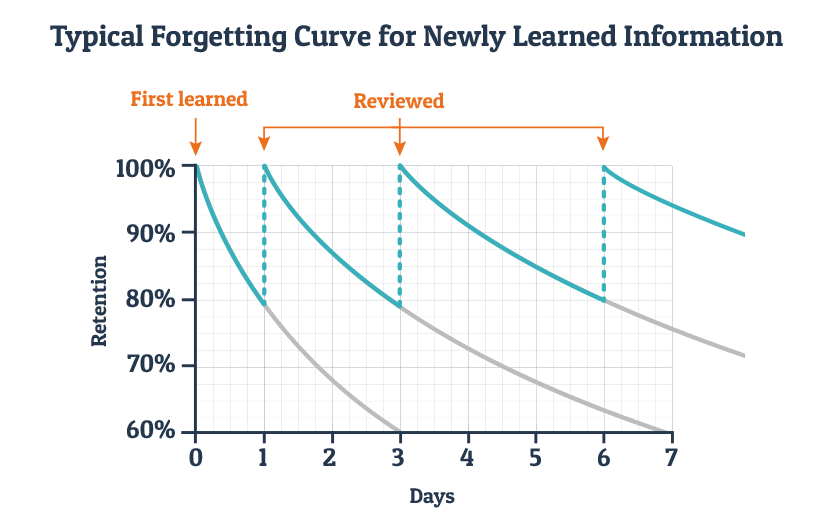
When you use a chunk, its activation level goes up.
No matter what you happen to be thinking about today, certain memories are more easily retrieved than others in general. A chunk's activation can decay until it reaches its base level. When we refer to "activation," we mean the current activation, and if we mean the base activation, we will call it as such.
To raise the base level activation, the agent tries to add a new chunk to declarative memory, but that chunk already exists. So the agent either adds a new chunk to the declarative memory, or increases the base activation of the same chunk that already exists there.